From a London Draper’s Son to Lord Mayor
An Unexpected Beginning
One of the biggest misconceptions about family history is that it belongs to “other people” — grand families, famous names, stories already written in history books.
Not ours.
Most of us expect to find ordinary lives in our trees: quiet ones, people who worked hard, raised families, and were slowly forgotten over time.
And for the most part… that’s exactly what we do find.
But every now and then, something unexpected appears — something that makes you stop and look twice.
A Name That Stood Out
When I began tracing this particular line, I wasn’t looking for anything extraordinary. It was just another branch, another set of names gradually taking shape.
Until one name stood out — my 7× great-grandfather:
A Lord Mayor of London.
And yet, today, what remains is not just a name in records — but a monument, still standing as a reminder of the life he once lived.
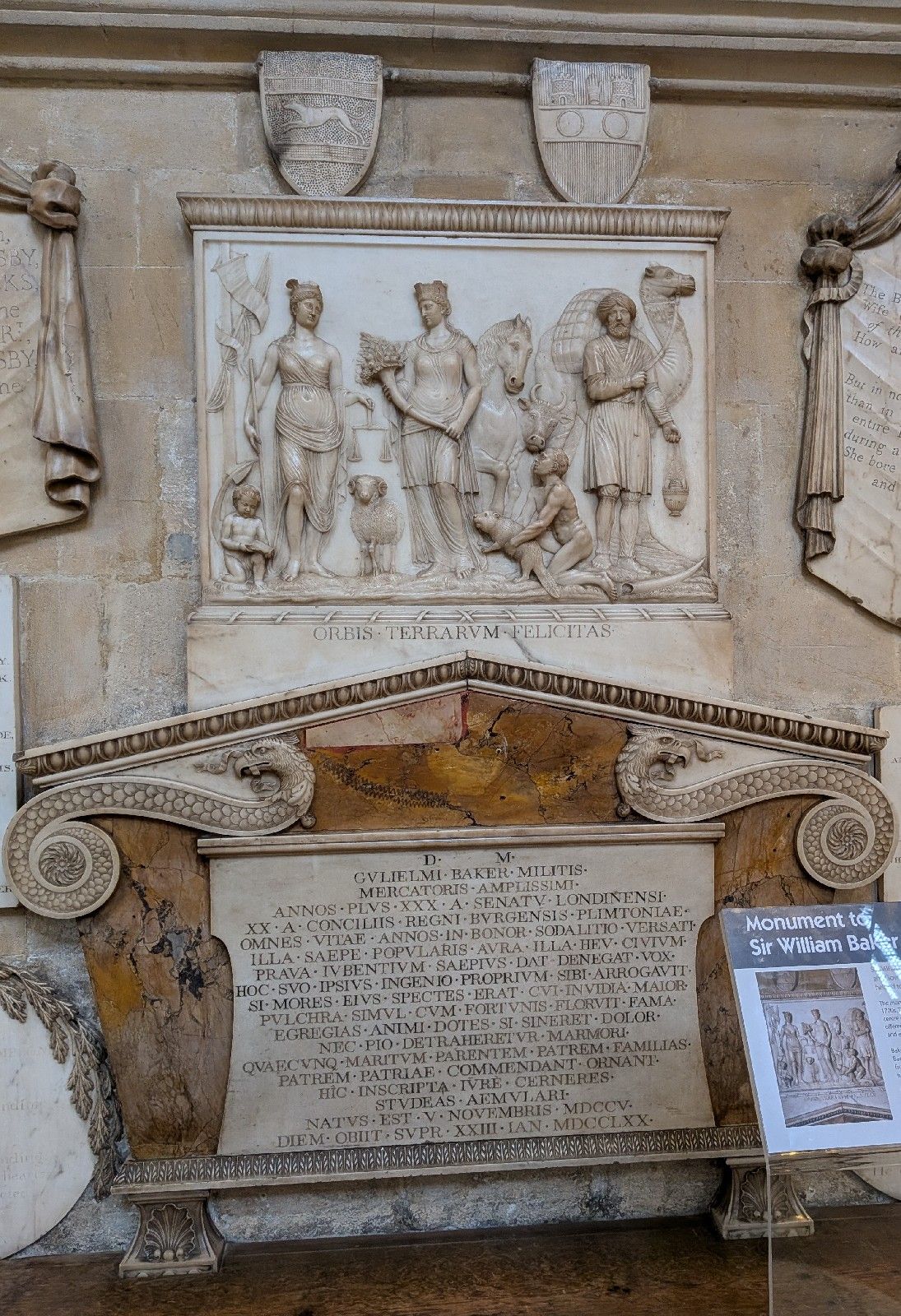
The monument to Sir William Baker at Bath Abbey, a lasting reflection of his life and contributions.
From Trade to Influence
Sir William Baker was born in 1705, the son of John Baker — a London draper.
A draper. Not nobility. Not royalty. Just a man working in the textile trade in one of the busiest cities in the world.
And yet, within a generation, that same family would rise into positions of remarkable influence.
Sir William went on to become Lord Mayor of London, a Member of Parliament, and a leading figure in major trading companies of the time, including the Hudson’s Bay Company.
His life placed him at the centre of a world shaped by commerce, expansion, and ambition.
A Life Reflected in the World Around Him
Sir William’s success didn’t just exist on paper — it was visible in the world around him.
In 1759, he began building a country estate at Bayfordbury, near Hertford. It was a time of huge significance in British history — during the Seven Years’ War, Britain celebrated major victories overseas that helped shape its growing global presence.
These moments weren’t entirely separate. As a leading figure in the Hudson’s Bay Company, Sir William was closely connected to trade and decisions that linked to Britain’s expanding reach.
Today, that connection is still visible on the map — Baker Lake bears his name, a lasting reminder of the reach his life once had.
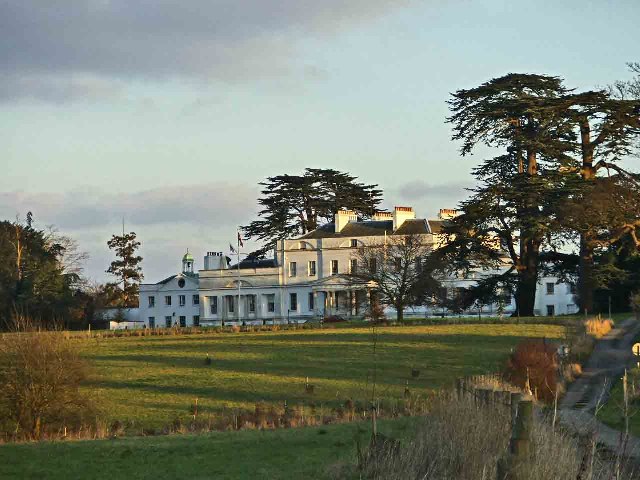
Image: Christine Matthews, CC BY-SA 2.0, via Wikimedia Commons
Family, Marriage, and Legacy
Sir William’s story is not just one of personal success, but of family connections.
He married Mary Tonson, linking the family not only to trade and politics, but also to the literary world of the time.
Together, they had several children, including his eldest son, William Baker, who inherited Bayfordbury and continued the family’s story.
His son also inherited a remarkable collection of portraits connected to his maternal grandfather, Jacob Tonson. These portraits belonged to the famous Kit-Cat Club, a group of writers and thinkers whose members included some of the most influential names of the era.
For a period, they were housed at Bayfordbury — bringing together family, literature, and history in one place — before eventually finding their way to the National Portrait Gallery, where they remain today.
A Glimpse of the Man Behind the Name
Seeing a face alongside a name can change everything.
A portrait of his son, painted by Nathaniel Dance, shows a refined and thoughtful figure, standing with a volume of Milton — a quiet symbol of intellect and status.
This portrait still exists today and was even sold at auction in recent years. It’s a reminder that these lives weren’t just names on paper — they were real, present, and once part of a world as vivid as our own.
Before London: The Reverend Joseph Baker
Looking further back, the story shifts again.
Before the merchants and political life of London, there was Rev. Joseph Baker, a 17th-century clergyman, born to John Baker and Elizabeth Moseley.
A very different life: quiet, educated, rooted in community rather than trade or politics.
And yet, still part of the same family line.
A Story Across Generations
Family history isn’t a straight path — it’s a series of turns.
- One generation builds something steady.
- Another expands it.
- Another transforms it entirely.
Woven through it all are marriages, children, and small connections that carry a family forward.
A Story Still Unfolding
What I love most about this discovery isn’t the titles or status.
It’s the contrast:
- From a reverend in the 1600s…
- To a London tradesman…
- To a man who would go on to help shape the city itself.
And then, slowly, back again into generations of everyday lives — names that feel familiar, closer, more like us.
Somewhere even further back, there’s mention of a John le Baker, born around 1090. But that’s a story for another day.
A Final Thought
Family history has a way of surprising us.
Not because every ancestor was famous — but because every line holds something unexpected:
- A connection
- A marriage
- A story quietly waiting to be rediscovered
Every family tree holds a little magic — sometimes it just needs the right person to uncover it.
If you’ve ever wondered what might be hidden in your own family tree, you might be more surprised than you think.
This family history discovery highlights how one ancestor’s journey from trade to influence, can reveal a much wider story of connection, ambition, and legacy across generations.
Interested in discovering stories hidden in your own family tree?
You can explore my research packages or get in touch to start your own journey of discovery.
You might also enjoy reading: